
Accessibility is not extra credit
It is life and death

Image description:
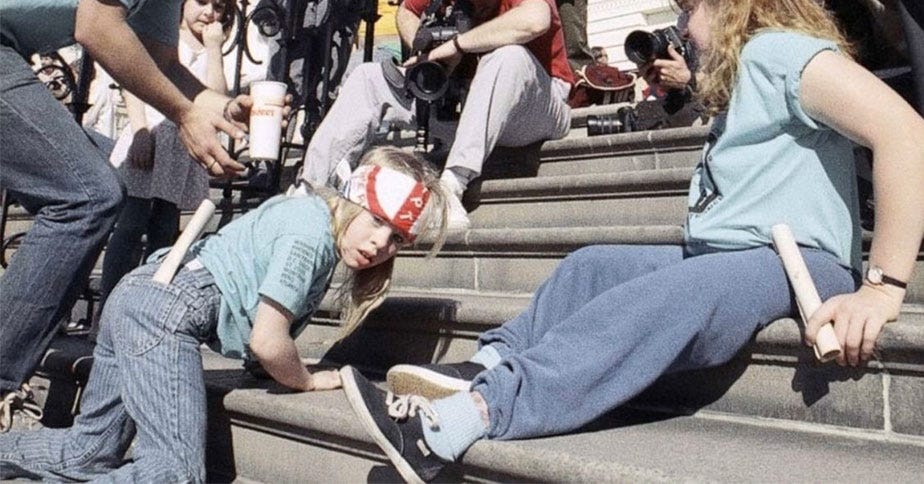
I’m acting like I’m dropping a bomb here but I’m really not. Reason #1 I’m pressed: I’m presenting this in the hot-take-o-sphere in hopes that we can give this issue a necessary spotlight but. I’ve said it, written it, screamed it for years. So many other disabled folks have been screaming this for years. They have been literally crawling their way through the world and occupying government buildings for weeks at a time and stopping buses in the street and going to jail to drive this point home.
.
This issue is not unique to disability: any time you are trying to make anything intersectional, trying to expand access or reach to some population, you risk hostility on either side of the negotiation. Someone thinks it’s too far, someone else doesn’t think it’s far enough, some Judy-come-lately has decided to make a stink now and paint everyone else as the bad guy, and yet another person still is just chafed at having to make an effort.
.
I know there are so many organizers bending over backwards to do the work behind the scenes to make sure everyone truly feels welcomed and appreciated at the table. I know that disability is a particularly tricky category for this work, because our needs are so varied, and worse, often contradictory. As someone who takes the work of disability inclusion seriously, while being quite limited in my ability to fully realize it, I know I’m never perfect on addressing everyone’s needs, as I’m one broke-as-a-bad-joke person doing what should be done by an entire (paid) team.
.
And yet. I am so beyond tired of a certain type of performative concern for disabled people, and while this could encompass a variety of valid access needs, I’d like to talk about something specific that so many people need, and everyone will need at some point if they stick around long enough, yet is thought of as a bonus: I’m talking about mobility accommodations. It’s weird, being figuratively, iconically hyper present: the handicapped symbol, the go-to explanation for the social model of disability, the very idea of crip studies, all reference those who move about the world in a way perceived to be non-normative. A way constructed to be non-normative.
Yet, I and so many others have to be grateful to even be able to enter, let alone move around in a way that doesn’t massively interrupt the flow of the rest of the place. Everyone has to move around, scooch, squeeze, squish. I bump into someone, I almost roll over another’s foot. I am made to be a nuisance, when I just wanted to exist in public.
.
Of course, there’s a degree of privilege to learn this later-ish in life gradually-ish. Yet, as my mobility has dropped sharply the past few years, I see how much of the world is closing off to me. Another mindfuck: I spend all day jumping up and down (figuratively) about disability justice, and yet I continue to experience a sharp, cut right precisely to the center of your soul with a light swift motion SHARP grief about how much more profoundly disabled I’m becoming by the day.
.
You don’t need to have read as many disability essays/books/long substack notes as I have to understand how fiercely the world hates disabled people. How it forms the category around everything someone can’t do, and thus why missing that ability is such a poison—implied, to you and everyone around you—that your very essence changes. You’re no longer you, you’re no longer normal: you’re a disabled person. You’re a crazy, sickly, monstrous, lazy, disheveled, scary, mysterious, treacherous thing.
.
The world screams this at you every day without saying a word. How many affordable homes are there in America without stairs? Seriously. And now figure out how many of them are genuinely wheelchair accessible. Now figure out how many of them are Section 8. Now go find an area near you with open waitlists within the next several years.
.
Now imagine you just got kicked out.
.
No one else you know has room, because everyone else who loves you is struggling too.
.
Now imagine on top of this, you still have to chase around doctors, prescriptions, insurance giving you another bullshit hoop to jump through so gratuitous that it’s somewhere long past Kafka-esque. Those moments where I just bury my head into something and yell, “JUST CALL ME A SLUR, WHY DONT YOU”
.
Now imagine on top of this, the constant fatigue, the every day pain, the struggling to get from place to place, nowhere to have a stable refuge or fully recharge, the crazy blood sugar crashes you’re constantly staving off, the panic attacks you’re shoving down, the depression you’re never relieved of, all the people bailing on you when your body gets too hard, the people accusing you of lying or exaggerating, the inability to have any recognition or help of all of these medical issues, the utter indifference of anyone whose responsibility it was to help you, all the life you’ve missed, the lives you’ll never have for no good reason.
.
Then you have to push that down and somehow endure a job all day that doesn’t even bother to consider that you might need an accommodation, so that when you ask for even a minor, insignificant adjustment that affects only your ability to get the job done in a positive direction, you get a look back hurt like a puppy dog that you’re not a proper team player, and an inattentive promise to think about it. The next day they ask you if you can stay longer. The day after you have a special project. The day after the day after that you get a suspicious, overly cautious greeting at work because you took a sick day.
.
Work never stops escalating, your body never stops escalating. You have less and less and less to give.
.
That is why I can’t compromise anymore. My body is a La Brea Tar Pits style monument to all I’ve had to overcompromise on for far too long. This push through, this grind yourself to dust mentality that we’ve been pedaled truly kills us all. Disabled people forever remain the canaries in the coal mine. Y’know, the sacrifices.
.
People still bizarrely treat my limitations like a first offer in a negotiation. While my physical abilities do fluctuate, my ability to perceive my own body’s range in a given moment is far more stable. The only snag is that you have to actually trust disabled people. You have to let go of a paternalism that says you know what’s best, or that I couldn’t. The only person who can accurately renegotiate my own body’s boundaries, at least in the sense of their being true, it’s me. In short: when I say I have a limit, I’m not asking you. That is information you need to take in and use to adjust how you will make this space fit my body. I’m constantly translating, interpreting this nonsensical, inconsistent, unintelligible language of my body.
.
That language is saying what I wasn’t allowed to for years: that I needed more. More concern, protection; accountability for people who harm me; someone I can ask for a hand, a little more comfort, more room, more breaks, more soothing tones, more grace, more time and energy for me.
.
I needed more help, more love, more care, more patience, more kindness, more understanding, more thoughtfulness.
.
I needed more people fighting for me.
.
I couldn’t be heard for years.
And now? My body refuses to not be heard.
.
It has the hard limits I never had. It is an 80-year old woman who gives no fucks whose back always hurts. She will hit anyone she has to with her cane.
.
She refuses to be an afterthought
.
.
.
.
.